
One of the most common pre-lesson questions we get is "what do I need to bring to a surf lesson?" Good news: a quality surf school provides all the actual surf equipment — board, rash guard, leash, wax. Your job is simply to show up sun-protected, hydrated, and in swimwear that survives a wipeout. Here's the full checklist we send to every student who books surf lessons in Tamarindo or stays at our surf camp.
What to Bring to a Surf Lesson (and What to Leave Behind)
The honest answer: much less than you think. Here's the exact checklist we give our students in Tamarindo — what to bring, what we provide, and what to leave at the hotel.
July 5, 2026 · Updated · 5 min read · By Victor Nuñez
🩳
Swimwear you can move in
Board shorts or a sporty one/two-piece that stays put when you wipe out. Avoid loose trunks without a drawstring and delicate bikinis — the ocean will claim them.
🧴
Reef-safe sunscreen (SPF 50+)
Apply 20–30 minutes before the lesson so it bonds to your skin. Zinc-based sticks for your face survive the water best. Costa Rica sun is equatorial — do not skip this.
💧
Water bottle
Two hours of paddling in 85°F weather dehydrates you faster than you expect. Drink before and after your session.
🧻
Towel & change of clothes
For after the lesson. Most surf schools (including ours) have a place to rinse off and store your things while you surf.
🩴
Sandals or flip-flops
The sand gets scorching hot by mid-morning. You surf barefoot, but you will thank yourself on the walk to the beach.
💵
A little cash
For a coconut, a smoothie, or tipping your instructor if they made your day. Cards work almost everywhere in Tamarindo, but small vendors are cash-only.
🏄 What the Surf School Provides
Everything below is included in the price of your lesson — you never need to rent or buy equipment for a beginner class.
🏄
Surfboard
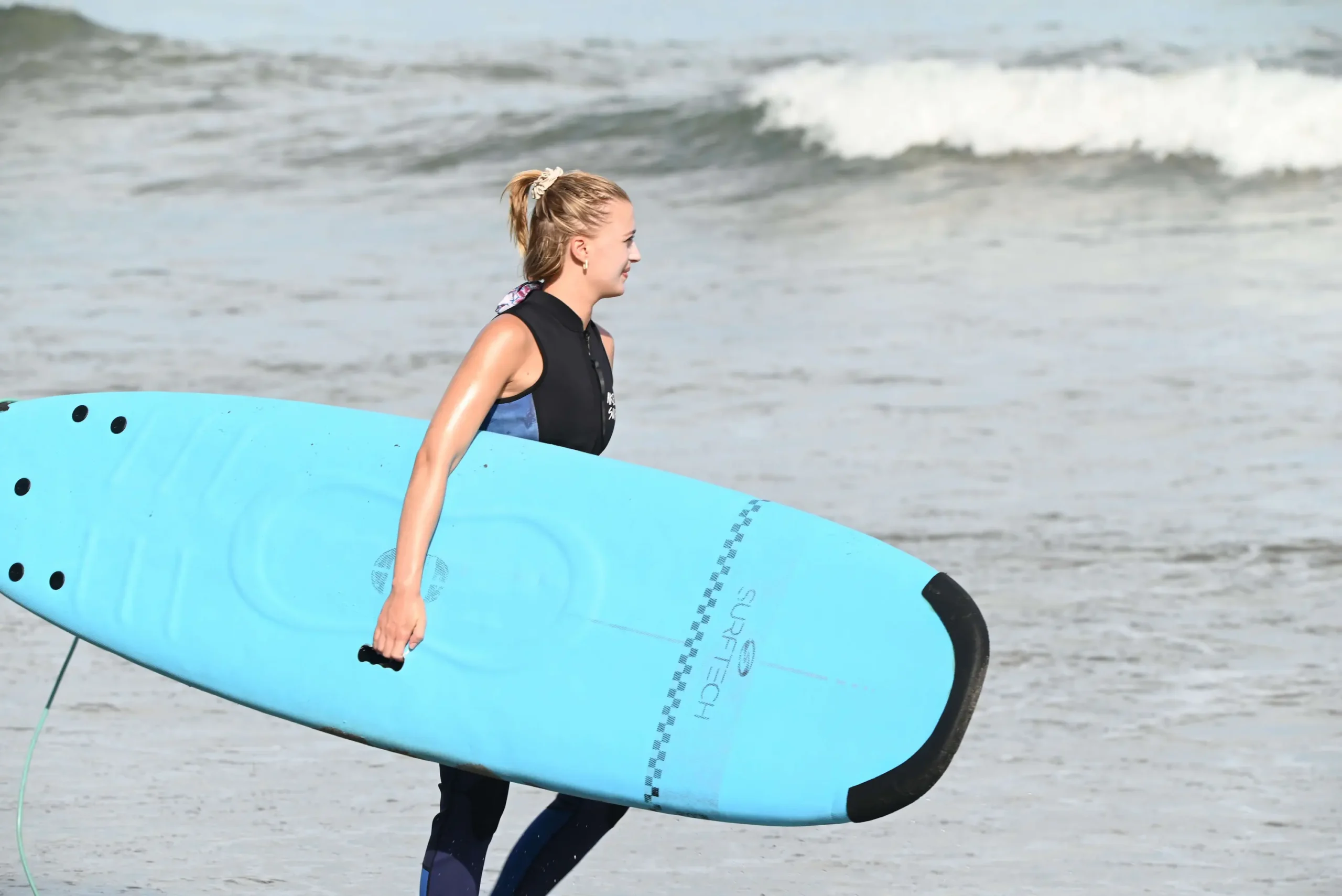
A soft-top beginner board matched to your size and level. No need to bring or rent anything.
👕
Rash guard
Protects you from board rash and sunburn. We provide one for every student, every lesson.
🦺
Leash & wax
All board equipment is set up and checked by your instructor before you hit the water.
🧑🏫
Certified instructor
Beach theory, in-water coaching, and safety supervision for the entire session.
❌ What to Leave Behind
- ✕ Jewelry, watches, and anything shiny — the ocean eats them
- ✕ Your phone (unless someone on the beach is holding it)
- ✕ GoPro on your first lesson — focus on standing up first
- ✕ Wetsuit — water here is 80°F+ all year, you will never need one
- ✕ Sunglasses — they will not survive the whitewater
Before-Lesson Tips from Our Instructors
- Eat light, 1–2 hours before. A smoothie or fruit is perfect. A full breakfast right before paddling is not.
- Sunscreen goes on 20–30 minutes early. Applied at the beach, it washes off in the first set of waves.
- Arrive 10–15 minutes before your slot. That's enough time to sign in, get your board, and meet your instructor relaxed instead of rushed.
- Coming from abroad? Check our complete Costa Rica surf trip packing list for what to put in your suitcase.
- Nervous? Read what to expect on your first surf lesson — it walks through the whole session step by step.
That's It — Now Just Show Up
Board, rash guard, and certified instructor included. Stand up on your first lesson — or your next one is free.
Frequently Asked Questions
What should I bring to my first surf lesson?
Just the basics: swimwear, reef-safe sunscreen applied 20–30 minutes before, a water bottle, a towel, and sandals. The surf school provides the board, rash guard, leash, and instruction — you do not need any surf equipment of your own.
What should I wear to a surf lesson?
Wear secure, athletic swimwear — board shorts with a drawstring or a sporty swimsuit. You will be given a rash guard to wear over it, which protects against sunburn and board rash. No wetsuit is needed in Costa Rica.
Do I need to bring my own surfboard to a lesson?
No. Every lesson at Pura Vida Surf School includes a soft-top beginner surfboard matched to your height, weight, and level, plus a rash guard. Everything is included in the lesson price.
What sunscreen is best for surfing in Costa Rica?
Use a reef-safe, water-resistant sunscreen of SPF 50 or higher, applied 20–30 minutes before entering the water. Zinc-based face sticks hold up best while surfing. Oxybenzone-based sunscreens harm the reef and wash off quickly.
Can I wear contact lenses while surfing?
Yes — most surfers wear daily disposable contacts without problems. Close your eyes when you fall and bring a spare pair just in case. Avoid surfing in glasses; they rarely survive a wipeout.
Should I bring my phone or GoPro to a surf lesson?
Leave your phone with a friend on the beach or in the school’s storage. Skip the GoPro on your first lesson — you will progress much faster focusing on technique. Many schools, including ours, can arrange photos of your session instead.
Need Help Choosing?
Not sure which option is right for you? Talk to our local surf team and we'll help you choose the perfect option.
WhatsApp Us